CRD Workshop ’12 Schedule and Registration
There’s still plenty of time to register for the Spring Workshop, “Digital Natives or Digitally Naive”.
Tentative schedule:
9:00 am – 9:45 am – Registration and Breakfast
10:00 am – 10:15 am – Introduction and Housekeeping
10:15 am – 11:15 am –
Keynote: So You Want to Get Started with Digital & Media Literacy? Considering the Why, Wherefore and How
Renee Hobbs, Professor and Founding Director
Harrington School of Communication and Media, University of Rhode Island
11:15 am – 11:30 am – Break
11:30 am – 12:30 pm – Discussion: The Four Dimensions of Digital Literacy
12:30 pm – 1:15 pm – Lunch
1:15 pm – 1:30 pm – Brief CRD Business Meeting
1:30 pm – 2:30 pm – Concurrent Breakout Sessions:
Collaborating to Revitalize Student Learning
Jackie Fritz, Faculty Liaison for Learning Technologies, Bucks County Community College
The Knowledge Commons at Penn State
Joe Fennewald, Head of the Tombros and McWhirter Knowledge Commons & Emily Rimland,
Information Literacy Librarian and Learning Technologies Coordinator, Penn State University Libraries
Multimedia Literacy: A Plan to Get Started
Shelly McCoy, Head Student Multimedia Design Center& Hannah Lee, Assistant Librarian, University of Delaware
2:30 pm – Tour of campus
Stay tuned for more information as it becomes available. Please direct all questions to Paul Proces (pproces@gmail.com). Register at http://bit.ly/diglit12.
iPad 3 Winner!
First, a thank you to everyone who responded to the CRD survey. We had over 270 people take the survey. Your input is very valuable to the CRD Board, and we will be looking at your responses in the coming months.
The CRD Board would like to congratulate Paige Andrew, Penn State Libraries, winner of the iPad3. Paige was one of the lucky survey participants who entered his name to win the new iPad. According to Paige, “I am thrilled and very thankful to have won it.”
Again, thank you to everyone who participated in the survey!
Info literacy is (or is not) equal to info technology
People on our campus are currently discussing information literacy and what it means to our curriculum. What sparked this discussion? None other than implementation of our new general education program. Faculty are in the midst of reviewing course proposals for their support of the University’s ten newly selected General Education Student Learning Outcomes (SLOs). The second SLO, labeled ‘Information Literacy,’ states that students will be able to “Find, evaluate, and ethically use information using appropriate technology.”
Right now, the discussion of information literacy centers on how broadly or narrowly this goal should be defined, and on the role technology plays in information literacy. Some faculty equate this goal with ‘information technology,’ stating emphatically the goal is all about teaching students how to effectively use technology. Interestingly enough, the faculty espousing this view are from the colleges of education and business. I have heard it said this goal is primarily about learning how to use technology, because technology is mentioned in the goal. I, and others, have responded that the goal clearly is about finding, evaluating, and using information using the appropriate technology, which may or may not be electronic. Most often it will be, but students should be able to judge when it is not appropriate. Is it appropriate to spend 3 hours using a library computer to search the Internet for an authoritative source listing a drug interaction, when a print or electronic book readily at hand contains the needed information? You be the judge.
OK, I admit I’m a little cranky on this topic, but I find no support for the idea that technology will solve all our problems. In fact, it often seems to create new problems that were unforeseen. To paraphrase Shane, from Jack Schaefer’s novel of the same name, technology is a tool, only as good as the people using it. I am not a Luddite by any means — I do not want to go back to the days of card catalogs, thank you very much — but I disagree with the assumption that using technology is, in and of itself, always a desirable act. Yes, technology is ubiquitous and we do have to learn to use it, but boy oh boy, I think we can benefit from being more critical of how we use it.
OK, so I’d like to hear what you think. Do you distinguish between information literacy and information technology literacy? How do you define technology? How do faculty on your campus define information literacy? Information technology literacy? What do you make of PA Forward’s definition of information literacy:
Information Literacy – Libraries can help all Pennsylvanians learn how to use online resources and current technology to improve their education, to enhance their job skills, and to participate fully in a digital society.
Do you agree with this definition? It seems to agree more with those on my campus who equate info lit with info technology. What do you think?
Registration Open for CRD ’12 Spring Workshop
Digital Natives or Digitally Naive: Lessons on Digital and Media Literacy
9 am-4 pm on May 24, 2012
Register here: http://bit.ly/diglit12
Program will introduce librarians just starting or just thinking about starting media support programs to digital and media literacy with thought-leader Renee Hobbs, Founding Director of the Harrington School for Communication at the University of Rhode Island. She will address the big question of “Why media?,” some of the commons concerns with starting a program (is a media project rigorous enough?), the role is strengthening a student’s critical thinking skills with regard to media (does this YouTube video have the facts right?). Dr. Hobbs will lead a discussion session on the 4 dimensions of digital literacy as well. The afternoon breakout sessions are effective media assignment design with Jackie Fritz (Bucks CCC), a session on multimedia literacy and media practice at Univ. of Delaware with Shelly McCoy & Hannah Lee and the Penn State Knowledge Commons overview and practice in the first semester with Joe Fennewald & Emily Rimland.
Breakout Descriptions
The Knowledge Commons at Penn State
A key element in the implementation of ‘Commons’ are the partners libraries build to create the ‘one-stop shop’ for students. These can be internal (lending, reference, instruction) as well as external (information technology, media, writing and math tutors). Additionally, each partner may have different priorities ranging from day-to-day operations to creating programs and outreach. In this session, the presenters will share their recent experience at Penn State but welcome and encourage you to share yours. The discussion will include the different types of partners libraries have established, problems encountered, and solutions explored in providing effective student-centered learning spaces in libraries.
Joe Fennewald, Head of the Tombros and McWhirter Knowledge Commons, and Emily Rimland, Information Literacy Librarian and Learning Technologies Coordinator, Penn State University Libraries
Collaborating to revitalize student learning
Well-designed assignments guide students in using media resources and technology tools successfully. Librarians lead the way on this path to obtaining learning goals by teaching instructional design, media literacy, and transliteracy skills to both faculty and students. Student and faculty products from New Media Literacy and Transliteracy professional development institutes demonstrate this approach, presented by Jackie Fritz.
Student Multimedia Research Center at UDel
The Student Multimedia Design Center at the University of Delaware Library has the space, hardware, and software for students to create multimedia. Adding a multimedia literacy component is the next step. Join Shelly McCoy and Hannah Lee as they present their thought process and strategy in starting their multimedia literacy program. Attendees will review and discuss ideas and considerations and be able to start outlining a multimedia literacy program for their library.
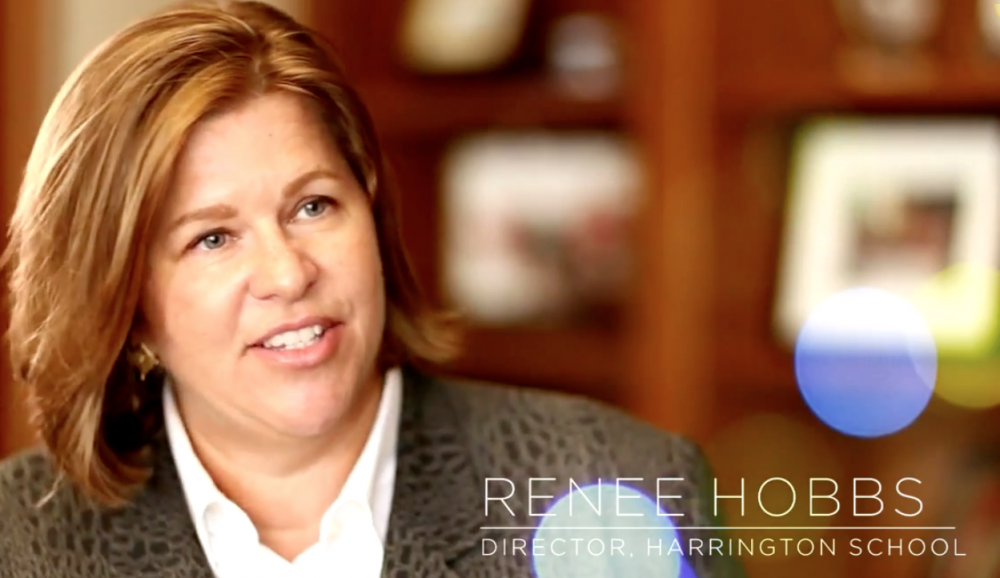
Renee Hobbs
Renee Hobbs is one of the nation’s leading authorities on media literacy education. She is a Professor at the University of Rhode Island, where she founded the Harrington School of Communications and Media, a new type of communications school emphasizing digital and media literacy in an interdisciplinary environment. She has created numerous award-winning multimedia curriculum materials for K-12 English language arts educators and students. Her book, Digital and media literacy: Connecting culture and classroom (20011, Corwin/Sage) paves the way for a connected vision of media education across the classroom, community and library.
Pricing
PaLA Member (includes lunch) $35
Student Rate (must show ID at Event) $20
NonMember/Late Registration $55
Maps
http://www.bucks.edu/about/campus/newtown/directions/
http://www.bucks.edu/about/campus/newtown/map/
Hotel Information
http://www.hamptoninn.com/en/hp/hotels/index.jhtml?ctyhocn=AVPNTHX
Hampton Inn & Suites Newtown
Mention Bucks Media Literacy Workshop for discounted rate of $119
Rooms reserved until May 11th
I completed the coursework for my MLIS in August 2011 and, throughout the time I was completing it, I had planned on working for an academic library. I didn’t care what size it was, I just knew I wanted an academic library where I would work with other librarians; I even worked in an academic library as an undergrad and tutored and taught at a community college while completing my degree. I was hoping to focus on reference, instruction, and outreach.
My post graduation plans didn’t work out quite as I had expected, and I’m now in a slightly different position than I pictured – I’m the one person in a one-person library, a small nursing school library that has a shoe string budget, no one to help me (not even an intern or a volunteer), and I’m also essentially a librarian who is “on call” when the medical center doctors need research assistance.
I never anticipated I would end up in a job like this, but when I accepted the position I knew it would be a challenge that would force me to grow and change and get out of my comfort zone, and I never shy away from a challenge. Also, the people I met the day of my interview were incredibly kind and enthusiastic and wanted to improve the library. So I put my skills to use managing all aspects of the library, and learning new things along the way.
Thankfully, while completing my undergraduate degree, I held multiple jobs in the university’s library. I had hands on knowledge in different areas than I focused on during my internship and coursework. But there was still so much I didn’t know, so much I didn’t have practical or classroom experience with, so much that, because I was so new, I just didn’t have time to gain experience with yet. Suddenly I was thrust into management and budgeting, collection development, purchasing recommendations, cataloging and classification, and computer and printer troubleshooting. And I was in the health sciences field, which I did not have much experience with. It was overwhelming to say the least, but what better way to learn everything than to have no choice but to jump right in?
I’m coming up on the end of my first complete semester here, and I have to say that I’ve learned a lot from my experience. I also learned some things that anyone working in a one-person library should know, especially since, with shrinking budgets, one-person libraries or libraries with a very small staff, are not exactly uncommon.
The Lone Wolf Librarian’s blog provides some highlights from anSLAwebinar that provided tips for the one-person library. Essentially, these highlights tell you that you must manage your “portfolio of services,” and understand what you should continue to do, what you should discontinue, and what services you should grow. You must also prioritize your duties and say, “No,” to low priority projects, promote your services without spending a lot of time and resources, form relationships with the “influencers” in your business, and view the library through the lens of “business terms.”
While those are very important tips, I’ve found one other to be extremely important – utilizing and expanding your professional network. My network has been invaluable during this time. When I started in my current position, the previous librarian had already retired, so I did not have anyone I could go to with library operations questions. Of course, I reached out to everyone in my organization to learn about how the library operated in the context of the organization, but when it came time to specific questions about topics like cataloging and classification, or which resources I should turn to when I needed to implement a budget-conscious initiative, I had to go outside of the organization.
Because of leaning on my professional network, I’ve learned the things I didn’t learn in school or in my previous work experience. Granted I learned those things in a “crash course” manner, but I also learned them within a real world context. Even something as simple as learning where to get cards I could run through the printer to print out cards for our real card catalog (yes, an actual print one!), was advice I got from a contact. In fact one of the biggest downfalls of my library school experience, and I believe this may be true for many, was not learning the non-automated way of doing things.
As I come to the end of my first full semester in this new library, I do realize how much I’ve grown and how much I’ve learned, and I see the value in learning how to do things in the non-automated fashions. I’ve had to adjust my expectations of what can and should be done because when you’re a one-person library, you have to learn there’s only so much one person can do. What I didn’t have to learn, but what I’ve had impressed upon me even greater than before, is the importance of leaning on that professional network. I will never get tired of seeing again and again how eager everyone is to help each other out in this profession, even when they are stretched thin and barely have enough time to get their own work done. With this in mind, I’m ready to face the challenges of next semester.
Bring it on, spring 2012!
Resources for one-person libraries:
Keogh, K. (2006, May). Solo librarianship: Unique challenges and opportunities for new librarians [Weblog]. Retrieved from http://www.liscareer.com/keogh_solo.htm
Leeder, K. (2011, November 30). Stories of 2011: One person’s (my) adventures in growing a new academic library [Weblog]. Retrieved from http://www.inthelibrarywiththeleadpipe.org/2011/stories-of-2011/
Pitts, R.L. (1994). A generalist in the age of specialists: A profile of the one-person library director. Library Trends 43(1), 121-135. Retrieved from http://www.ideals.illinois.edu/bitstream/handle/2142/7945/librarytrendsv43i1i_opt.pdf?sequence=1


 Adam Balcziunas
 Alex K.
 Alexandrea Glenn
 Andrea Pritt
 aprilnkelley
 Ashley Purvis
 Bethann Rea
 blj13
blj13 Brendan Johnson
 Amanda Boyer
 Bret Stiffler
 Bonnie Powers
 Christopher Lemery
 clarewithers
 clblibrarian
 Kelly Clever
 Charlotte M. Johnson
 colemanluzerne
 CRD of PaLA
 crdvirtualjournalclub
 cre5314
 csgarth
 Erin B.
 danajkerrigancv
 denisewetzel1
 Darren G. Poley
 elm43
elm43 James D'Annibale
 Annie Jansen
 Jill Hallam-Miller
 jennifercribbs
 Jenn Monnin
 Jen Hasse
 Jessica Showalter
 johnmeier1
 Kelly Safin
 Kim Karim
 Kristen Seikaly
 Kayla Van Osten
 Cecelia Lasley
 librarianjsmith
 Linda Neyer
 mabogino1
 Matthew McNelis
 Meg Massey
 Maggie Savidakis-Dunn
 Rebecca
 miskatoniclibrarian
 Maureen Bentz
 Michele G. Anfuso
 Nicole Miyashiro
 paulmcmonigle
 Rob Sieczkiewicz
 ronlmccoll
 Sam Bardarik
 shannahollich
 smartin592
 Ula Lechtenberg
 It's Academic