Word Wrestling Federation: WSDS Implementation
As metadata wrinkles are ironed out and e-content providers get a better view over Google’s shoulder as to best practices in user interface/HCI, Federated Search agents or Web-Scale Discovery Services (WSDS) are becoming an ever more prevalent resource in our collective toolkits. These ubiquitous interfaces offer the informed user an unprecedented level of access and discovery and bring the full breadth and depth of both a locally and remotely hosted collection to the uninitiated user’s fingertips.
Or so the brochures all say :)
In my own experience, WSDSs aren’t always as successful as the designers (or users) would hope once the wrapper comes off and the research begins. There’s many a slip twixt the cup and the lip, and choosing the right WSDS for your user base and teaching them to wield it deftly can be both inspirational and Sisyphean. As with most technologies, success in application depends upon selection of the right tool and its proper introduction to the intended user base. Here are just a few best-practices and considerations that have been useful in my capacity as both an evaluative potential buyer and a research guide:
Shopping
- Metadata & local collection integration – When evaluating different systems be sure you take a hard look at what WILL and WILL NOT be crawled in the new federated space. Will you be asking users to visit one space for the local catalog and another for database collections? Will on-campus users AND remote users have the same access experience, or will there be an additional authentication process?
- Round out your evaluative team – once your trial period with a product begins be sure you include colleagues with expertise and a mind toward differing service areas for a better-rounded product evaluation (Bibliographic/Metadata, Cataloging, Web Services, Circulation etc.)
- Usability testing – Test, test and retest. Use every moment of a negotiated BETA rollout to have your information professionals and a select group of student users put the platform through its paces. At the very least you may end up getting a jump start on your own user guides—and at most you may be able to identify issues before final contracts are signed. Whatever method you choose, be sure you collect all relevant feedback in a tangible manner and be prepared to call on it when defending (or criticizing) the system. Hit the system with queries it doesn’t expect and note how it responds. Think of every way you’ve seen a user misuse a system and try it; sooner or later, someone will anyway, and it’s better to find out the system can’t handle exceptions smoothly before you’ve paid for it.
Engaging
- Read the literature – Some of the bigger and better WSDS platforms are built by very familiar content providers (*cough* EBSCO *cough*), but don’t assume that the best and brightest of the interface you knew still represents what’s possible in the new federated environment. Take the tours. Watch the videos. Be ready to recommend any and all facets of the interface to users so that your implementation team has a realistic and well-rounded data set—and to build your own knowledge base of how useful (or not) these features are.
- Put it on Market & Front Streets – make sure you advertise this new service widely through the university to both students and faculty alike—you’ll want their feedback and will need the usage data. Also, be sure to include some indicator of the limits of the search “…locates MOST but not all of the items in our collection. If you aren’t able to find what you are looking for please see a librarian…” so that any query-based frustrations can be vetted as to whether the new interface played a part.
- Get feedback post-implementation – whether through a direct feedback agent such as a linked or embedded survey, platform-provided metrics, or through casual user interactions at the Reference and Circulation desks, stay informed as to what is and isn’t working. What is being used? Ignored? Why?
- Power in Subject Term searching for new users – Given the improvements in UI shaped by commercial giants in artifact discovery, intermediate or advanced searchers will most likely adapt to the new platform as long as the navigation and filters approximate what they had been used to. New users, on the other hand, will meet a deceptively simple basic search interface and then be buried under the crush of results from every corner of your collection. Teach them to look for and use the subject indices and terms as filters to quickly get them into the right “ballpark”.
CRD Spring Program — register now!
The PaLA College & Research Division announces its spring 2015 program:
- “The Times They Are a Changin’…Again: Exploring the New Roles of Libraries in Higher Education” featuring keynote speakers Melissa Bowles-Terry (University of Nevada Las Vegas Libraries), and Nancy Kranich & Megan Lotts (Rutgers University)
- Includes an afternoon panel session with PA librarians
- May 29, 2015, at Millersville University
- Find full event details on the “Upcoming Events” page at https://crdpala.org/upcoming-events/
- Registration for the program is now open at http://www.palibraries.org/events/event_details.asp?id=606838
Write for PaLRaP, Volunteer with PaLRaP
Pennsylvania Libraries: Research & Practice (PaLRaP) provides an opportunity for library and information professionals in Pennsylvania to share their knowledge and experience with practicing librarians across the Commonwealth and beyond.
To keep turning goals into reality, PaLRaP invites you to get involved. The journal is always looking for a few good professionals to contribute their ideas, words, interests, skills, and energy.
Here are some ideas on what you can offer.
Author an article
Tell us all about how you practice and perfect librarianship where you work. Publish your research. Take a stand on an important library issue. Turn that poster session or presentation into a masterwork!
Or simply stated, author an article for PaLRaP.
The next issue is due out in the spring (remember spring?), but you can submit a manuscript to PaLRaP at any time. Whether it’s a research or practice article, a feature, a commentary, or a letter to the editor. PaLRaP welcomes your contributions. See the submission guidelines and section policies for more information.
Share your news
Staffing changes, awards and recognition, upcoming events, new initiatives–what’s happening in your library is surely of interest to others in libraries throughout the Commonwealth. So why not submit a news item to PaLRaP? The submission deadline for the spring issue is April 3, 2015.
Become a peer reviewer
Maybe writing’s not your thing, but conducting library research and carrying out library practice are. Help our authors make writing about research and practice their thing by serving as a peer reviewer.
Peer reviewers are always needed by PaLRaP to provide thoughtful, critical analysis of the wide variety of topics that Pennsylvania’s librarians deal with and discuss.
PaLRaP follows a blind peer-review process, meaning you won’t know who the authors are and the authors won’t know who you are–all the better to guarantee high-quality, bias-free scholarly content.
To be considered for a place as a peer reviewer, submit your résumé to the PaLRaP editorial board. Be sure to tell the board about your reviewing interests and expertise.
Volunteer to copyedit, do layout, or gather news
PaLRaP is always on the lookout for sharp-eyed copy- and layout editors. Share your strengths by helping showcase authors and their work through careful copyediting and visually appealing layouts. If you want to practice your editorial skills or learn new ones, contact the PaLRaP editorial board.
PaLRaP will also soon begin the search process for a new coeditor for its news section. A formal announcement is forthcoming, so watch this space for details on how to apply.
All about PaLRaP
Pennsylvania Libraries: Research & Practice (PaLRaP) is a peer-reviewed, online, open access publication sponsored by the Pennsylvania Library Association’s College & Research Division. The University Library System, University of Pittsburgh, serves as the journal’s publisher.
PaLRaP includes articles from all areas of librarianship, with a special focus on activities at or of interest to Pennsylvania’s academic libraries. PaLRaP is published twice a year, in the spring and fall.
For more information about Pennsylvania Libraries: Research & Practice, to read past issues, or to submit an article, visit the PaLRaP website.
Children’s Literature Conference
Join us for our 19th Annual Pitt-Greensburg Children’s Literature Conference, Friday May 1, 2015
Educators, librarians, and writers are primary audience for this annual event.
Conference fee: $70 if postmarked on or before March 31, 2015, $80 thereafter.
Collaboration with the Campus Community
Hi! My name is Hilary Westgate, and I’m the Information Literacy Librarian at Misericordia University and part of the new blog team for the PaLA-CRD blog! I’m the liaison to the English, Communications, Fine Arts, and Religious Studies departments, the FYE program, and the Writing Center, and I also assist with our outreach programs and services. I attended Rutgers University for my MLIS and graduated in May of 2012, and I came to Misericordia in August of that year, so I am still fairly new to the profession. I’m honored to be a part of this blog team and hope that I can bring you some interesting and useful discussions!
I’d love to open up a conversation here about collaboration with other departments and groups on campus. Since I’ve been at MU, I’ve been fortunate to work with staff and faculty members from other departments who are interested in pairing with the library on special programs and projects. In particular, the Student Success Center and the Writing Center have been amazing partners in collaboration. As a couple of examples, we have offered workshops together in which librarians and the Writing Center coordinator have co-taught about citation styles and formats, and I have offered cross-training opportunities for Writing Center tutors about aspects of their work that coincide with where the library can help.
Our most recent project in this partnership is a satellite Writing Center in one of our new study rooms in the library. We recently had eight new study rooms installed on the second floor of the library, and they are extremely popular with our students, especially because the walls are white boards! It’s amazing to see students filling up the walls with words and diagrams as they study. For three evenings during the week before Spring Break, from 5:00—9:00 p.m., we had writing tutors come to the library and set up to offer their tutoring services in a library study room. At the same time, some writing tutors remained in the original Writing Center location. Unfortunately, for our very first try with this outreach project, the writing tutors did not have students drop in to meet with them. We are looking forward to tweaking our approach a bit to offer the same service in April during the week before finals, and we are hoping for greater visibility and increased attendance from our students. We now know what we would like to change and improve for next time!
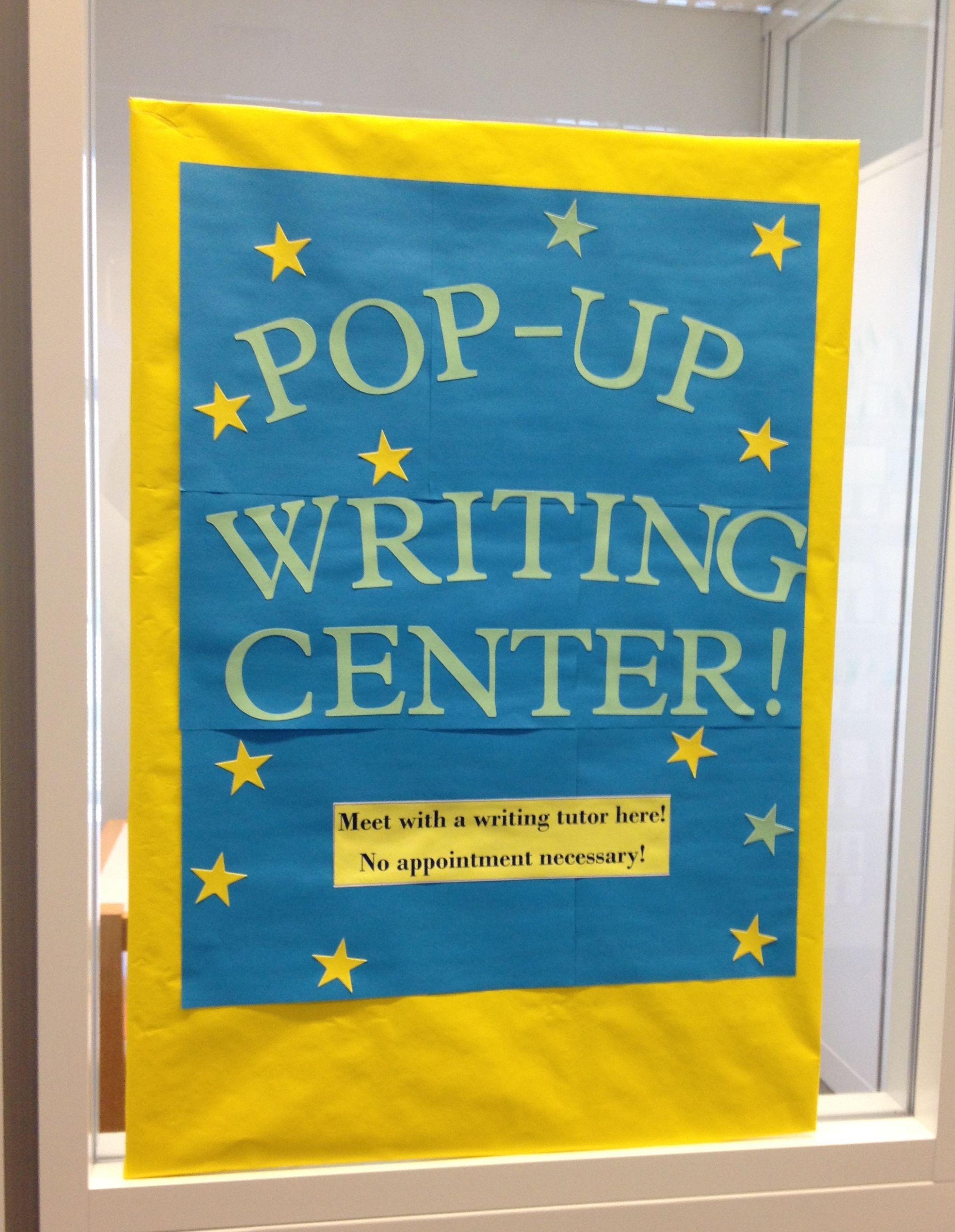
This sign was placed in the window of the designated study room, along with other directional flyers throughout the building.
What are some of the ways in which your library works with other departments and groups on your campus? What has worked well (and not so well) for you? Please share in the comments!


 Adam Balcziunas
 Alex K.
 Alexandrea Glenn
 Andrea Pritt
 aprilnkelley
 Ashley Purvis
 Bethann Rea
 blj13
blj13 Brendan Johnson
 Amanda Boyer
 Bret Stiffler
 Bonnie Powers
 Christopher Lemery
 clarewithers
 clblibrarian
 Kelly Clever
 Charlotte M. Johnson
 colemanluzerne
 CRD of PaLA
 crdvirtualjournalclub
 cre5314
 csgarth
 Erin B.
 danajkerrigancv
 denisewetzel1
 Darren G. Poley
 elm43
elm43 James D'Annibale
 Annie Jansen
 Jill Hallam-Miller
 jennifercribbs
 Jenn Monnin
 Jen Hasse
 Jessica Showalter
 johnmeier1
 Kelly Safin
 Kim Karim
 Kristen Seikaly
 Kayla Van Osten
 Cecelia Lasley
 librarianjsmith
 Linda Neyer
 mabogino1
 Matthew McNelis
 Meg Massey
 Maggie Savidakis-Dunn
 Rebecca
 miskatoniclibrarian
 Maureen Bentz
 Michele G. Anfuso
 Nicole Miyashiro
 paulmcmonigle
 Rob Sieczkiewicz
 ronlmccoll
 Sam Bardarik
 shannahollich
 smartin592
 Ula Lechtenberg
 It's Academic