Social Listening By Committee
 As Access Services Librarian, I manage circulation, interlibrary loan, and the college archives. I supervise twenty student workers, two interns, and three staff members. I’m involved with instruction, as an embedded librarian in history classes held in the archives and as a first-year experience instructor. While marketing and social media are my passion, they are not always my priority.
My library added our social media channels late in comparison to our peer institutions. Our Instagram started in Sept. 2015, Facebook followed in June 2016 (showcasing our recent renovation), Twitter was next in February 2017 and Tumblr in June 2017 (capitalizing on the college’s wonderful and often unseen archival collection).
With the creation of our Facebook account, I was asked to establish a social media committee. It included another librarian, a part-time staff member, plus four savvy student workers. We met weekly and the feedback the students gave was critical. It was also really important to me, considering all my responsibilities, to carve out time for social media.
Often times I didn’t agree with or understand the students’ comments, suggestions, and feedback, but I really listened and thought critically about what they had to say. Many times they had very thoughtful and insightful ideas and suggestions and contributed at a high level. The committee’s feedback was and still is invaluable. The majority of what the students shared about their expectations of social media and specifically the library’s social media was echoed in more formal educational conferences and workshops that I have attended in the last few years.
The students also encouraged the committee to engage in what I later discovered to be “social listening” or monitoring digital conversations to gain insights about our followers. And while I interpreted it at first as “creeping,” I found value in understanding our social media audience.
While I’m sure no one really wants another meeting to attend or committee to join, I encourage you to carve time out of your busy schedules to listen to your audience in person and online. Once you have feedback, truly listen and act on suggestions when appropriate. This gen-Xer doesn’t always get it, but I haven’t stopped trying to understand and neither should you.
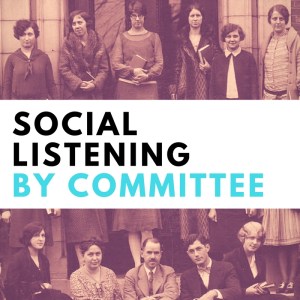
(Photo credit: Lebanon Valley College Archives, “Readers Club,” Quittapahilla yearbook, Internet Archive, 1930, http://bit.ly/2opCmiJ)
Collection Assessment & Faculty
Does the title of this blog post strike fear in your heart? It worried me a little (OK maybe a lot) as I looked down the project timeline for a much-needed library renovation that is happening at W&J. The size of our library is not changing in this renovation but we are adding more open/collaborative study space. Therefore, we have been working on an extensive collection assessment project focused on reducing the size of our collection. Speaking with one of our senior faculty members she believes it may have been 20 years or more since a project like this was undertaken.
Going into this project all the librarians felt that the only way for this to be successful was for the library to be very transparent and inclusive in our decision-making. Throughout the fall semester, each liaison librarian reached out to their departments and asked for a chance to attend a department meeting. These meetings yielded really good conversations with the faculty about what resources they’re asking their students to use, what criteria might suggest a resource is no longer relevant to their field, and how the library, in its new space, can work with them to better serve our students. While not everyone is enthusiastic about reducing the size of the collection, I think that through this open dialog they at least feel that their concerns have been heard and that we are willing to work with them to make sure we aren’t removing anything that is a core resource.
Based on the criteria determined by each department we used purple dots to mark the spines of books that met those criteria. Now we are in the phase where faculty members are coming to the library to review the dotted items. They have the option to save dotted items and dot other items for removal. Feedback from the faculty who have come in so far has been really positive. They said they were dreading reviewing the books on the shelf, however, they found value in really taking time to look at their collection as a whole, rather than just locating the one book they needed and grabbing it from the shelf. Some faculty have indicated finding gems that they didn’t know we had in our collection. One faculty member is meeting with students from his class, in the library stacks, to look on the shelves for book resources that pertain to their research topics.
So while this aspect of the renovation was something I was initially fearful about, I think it has been a huge opportunity for us to forge better relationships with the faculty, particularly in departments that haven’t traditionally been big library users. We look forward to working with faculty to acquire resources that fill identified gaps in our collection and we plan to implement a schedule for collection assessment where we will invite departments to come in every 3 or 4 years for a happy hour in the stacks.
If you’re interested you can follow along with our renovation project here, http://libguides.washjeff.edu/renovation.
Has anyone else had experience with this type of large-scale collection assessment? I’d love to hear your experience.
I Wanna Market Libraries When I Grow Up
 When I was an undergrad, like many students I teach now, I couldn’t put a name to what I wanted to “do with my life.” I liked customer service, art, writing, graphic design, and I also loved libraries and the freedom they embody, so I became an English Communications major.
Right out of college, I was lucky to get a job in a library and obtained my MLS while working there. Since then I have worked in public, community college and four-year college academic libraries. In these libraries, I have created, organized, designed, and contributed content to newsletters, flyers, blogs, websites, social media channels, etc. all while juggling other more important or pressing job responsibilities.
Last fall I attended the Library Marketing and Communications Conference. For the first time after many years of doing this work, I got to step back and consider how much these “other duties” impact libraries and how much this work meant to me.
Inspired by my students and this conference, I realized how marketing libraries is a culmination of my education and work experience. I came back almost feeling “called” to promote libraries and I had the drive to learn more about the subject.
Therefore, my future blog posts will have a practical focus on social media marketing of small academic libraries. Again I am not an expert, but an interested practitioner who hopes by sharing my knowledge, success and failures we can all do better.
(Photo credit: Lebanon Valley College Archives, “Maureen E. Anderson,” Quittapahilla yearbook, Internet Archive, 2000, http://bit.ly/2GljLf2)
On the Spot: Why I value chat reference services
The first rule of reference? Be visible and approachable (see RUSA Guidelines for Behavioral Performance of Reference and Information Service Providers).
On a reference desk, this is somewhat easy to do. Desks are typically located in a visible, (hopefully) high-traffic area. The staff member at the desk then tries his or her best to be “approachable” – your mileage may vary; bright yellow PLEASE INTERRUPT ME buttons are still common conference giveaways. But the desk is there, in sight for anyone who would come to your library to visit it.
So the desk is visible, but is it always approachable? You may say, yes, as long as a student is on campus, they can approach us. But what if their campus isn’t physical? At Penn State, we serve more than 18,000 online students through World Campus. They deserve equitable access to library resources that their on-campus counterparts receive (see ACRL Standards for Distance Learning Library Services). In my experience, World Campus students make up a large component of those I assist through chat reference, though I do also assist students from all of our campuses.
Chat reference is stressful. You don’t always know the answer, and it may be hard to quickly find someone who has the right answer or expertise to help with a highly specific research question. You may be bombarded with question after question. And yet, I volunteer for shift after shift, along with a large number of my colleagues. I often think of the students, especially those at a distance, who may be equally frustrated that they cannot physically walk into their campus library and request help. It is crucial that they have the opportunity to seek and receive research help, making chat reference a vital library service.
Think pieces and social media comments often bemoan the anonymity of the internet. People can be more awful to each other because it is easy to forget that there is a real person behind a screen name. Though sometimes I will receive spam chats, they are not very common. I think that the anonymity of chat reference can be freeing for students, who may be afraid they are asking a “stupid” question, or may feel overwhelmed by their assignment.
Consider a very visible reference desk. It may be approachable in terms of location – but if a student can easily see you, then it means that everyone else can easily see them when they ask for help. That visibility may be a struggle for some. Perhaps speaking is difficult for them.
But in a chat reference situation, there is no one behind a big desk to intimidate. There’s a chat box for you take your time and type out your question. If you’re nowhere near a campus, help is still available. If you’re on campus, but can’t (for whatever reason) visit a desk, help is a click away.
More than half of my reference transactions take place via chat reference – though I spend about equal amounts of time per week on chat reference and a traditional reference desk. I am always working to improve my chat references interactions, and encourage my fellow librarians to become more involved with our chat reference services. It can be a lot of work sometimes, but there are immediate outcomes, especially for students who have pressing information needs. And if you like being in the hot seat, there are always plenty of questions for you!
Connect & Communicate Series: IF I APPLY video ready
Thank you to everyone who attended our Zoom session, IF I APPLY, held on Friday, Feb 16, 2018. You will need a password to watch it. Session will be available for 30 days.
Video Link is here: IF I APPLY Zoom Session
Access Password: palacrd
Thank you Kat Phillips, Eryn Roles, and Sabrina Thomas for this excellent update to the CRAAP method for evaluating resources. Many of our attendees were excited to see and hear about this new method.
Thank you to Sara Pike for doing our closed captions, and Amanda Avery for moderating.
Kat, Eryn and Sabrina have kindly shared their PowerPoint: IF I APPLY Updated CRAAP Test for Evaluating Sources Webinar, handout:IF I APPLY SOURCE EVALUATION, and LibGuide.
If you participated in this session, please fill out the evaluation form here.


 Adam Balcziunas
 Alex K.
 Alexandrea Glenn
 Andrea Pritt
 aprilnkelley
 Ashley Purvis
 Bethann Rea
 blj13
blj13 Brendan Johnson
 Amanda Boyer
 Bret Stiffler
 Bonnie Powers
 Christopher Lemery
 clarewithers
 clblibrarian
 Kelly Clever
 Charlotte M. Johnson
 colemanluzerne
 CRD of PaLA
 crdvirtualjournalclub
 cre5314
 csgarth
 Erin B.
 danajkerrigancv
 denisewetzel1
 Darren G. Poley
 elm43
elm43 James D'Annibale
 Annie Jansen
 Jill Hallam-Miller
 jennifercribbs
 Jenn Monnin
 Jen Hasse
 Jessica Showalter
 johnmeier1
 Kelly Safin
 Kim Karim
 Kristen Seikaly
 Kayla Van Osten
 Cecelia Lasley
 librarianjsmith
 Linda Neyer
 mabogino1
 Matthew McNelis
 Meg Massey
 Maggie Savidakis-Dunn
 Rebecca
 miskatoniclibrarian
 Maureen Bentz
 Michele G. Anfuso
 Nicole Miyashiro
 paulmcmonigle
 Rob Sieczkiewicz
 ronlmccoll
 Sam Bardarik
 shannahollich
 smartin592
 Ula Lechtenberg
 It's Academic