Save the Date: CRD Spring Workshop
SAVE THE DATE!
The College & Research Division’s Spring Workshop, “Open Educational Resources in Pennsylvania Academic Libraries,” will take place at Shippensburg University on Thursday, May 24, 2018.
Mark your calendar, because you won’t want to miss it!

2018 GPLLA Legal Research Course
Are you relatively new to legal research? Unfamiliar with some of the core sources or methods used when finding the law? Just looking to brush up your skills? We are pleased to announce the GPLLA Legal Research Course for 2018:
Dates: Tuesdays, April 4 – May 9
Time: 5:15-6:30 p.m.
Location: Online (live and recorded)
Registration: $50 for non-students / $25 for students (Register Here)
This 6-week introductory legal research course is geared towards professionals and students interested in learning the basics of legal research or needing a refresher. The course will be presented by instructors from various Philadelphia area law schools and firms. Topics to be covered include an introduction to the legal system, statutory research, researching case law, using secondary sources, researching administrative law, and using paid and free services to locate the law. Each session will cover both federal and Pennsylvania-specific materials, so participants will be able to start familiarizing themselves with researching in both jurisdictions after each session.
The course will be presented online live using Zoom, and participants will be able to access videos of each session and related materials on demand as well. Westlaw and Lexis Advance have agreed to supply temporary accounts to all participants for the duration of the course. Specific technical requirements will be emailed to participants closer to the course start date.
Registration for the course is $50 for non-students and $25 for students. Payment may be submitted via check or PayPal. Specific payment instructions are included on the registration form, which may be accessed by clicking here.
Feel free to share this announcement with anyone you think might benefit from taking this course, regardless of their affiliation with GPLLA. If you have any questions, please contact Ben Carlson (benjamin.carlson@law.villanova.edu).
Find more information about GPLLA at http://gplla.org/w/.
For Future Reference
A recent library listserv discussion took up the issue of replacing lost or outdated print reference works. Respondents to the thread recommended digital resources instead of books in print, defending their choice by pointing to the fact that students simply do not consult print sources anymore. While I do not question this logic, I do wonder if there is a way we might actually get more students to turn the pages of dictionaries or encyclopedias, almanacs or handbooks. Most of these volumes, after all, will remain on our shelves for the foreseeable future and efficiently directing students to surrogate or related digital options through a LibGuide, for example, comes with its own set of challenges.
Just how can we possibly do this? For inspiration, we might turn to museum curation, and the work already done by many of our colleagues in special collections departments.
 While nearly every library creates temporary displays featuring books from its collections, relatively few in my experience present these items with accompanying descriptions. In many cases, a book can be judged by its cover, or the context of the display itself. Often, however, much remains unsaid and the casual viewer of a display is left to deduce a lot about a book, often one locked behind glass. We provide even fewer clues, outside of the online catalog record, about the books that remain on our shelves and never make that rare appearance in a library display. At least when a book is in a display case its title page or, if featured on a new arrivals shelf, its glossy cover help tell something of its story. In the stacks, however, the endless array of spines say little about our books’ actual contents.
Consider again the reference collection. How might a number of strategically placed descriptive book labels potentially impact users? Could labels help students who would rather browse the reference collection than approach a librarian for suggestions or consult a paper or digital bibliography on a subject? Could labels serve as landmarks to help librarians direct students to selected titles? I am not certain, but I have a strong sense they might.
 There is an art to writing good museum labels and a certain investment of time is required of anyone who would do it well. One advantage for libraries is that labels placed near standard works of reference on the shelf may remain in place much longer than they would for the limited lifetime of a museum exhibition. Furthermore, many book publishers already produce succinct descriptions or bulleted contents of their titles, which might be easily paraphrased or directly quoted to save time.
Reference books can be singled out for a label based on several criteria. Subject librarians are likely already familiar with works helpful for the most common assignments on campus. Additional titles might be labeled when they have no electronic equivalent or are classics in their field.
Of course such readers’ advisory labels might be created for different reasons, and to somewhat different effect, in other sections of the library. For now, I am interested in reviving a few reference tomes. Watch out general collection! If this works, you are next.
Information Age guru and futurist Marshall McLuhan pithily synthesized his early theorizing in a much-vaunted creative anthology The Medium is the Massage: An Inventory of Effects. McLuhan proclaims on page 75, “We look at the present through a rear-view mirror. We march backwards into the future.” While connections between McLuahanisms and libraries are most often made by way of information technology, this specific aphorism has more to do with librarians as people than the conglomeration of media we use in our everyday work.
We need to ask ourselves; do we agree we are looking at the present in a rear-view mirror when it comes to our professional life? It is easy to think of ourselves as walking backwards since we have a clearer view of our past than we do of our future, but McLuhan says we are looking “at the present” by means of a device that is designed to look behind us while driving a car. This would imply we are speeding along, and what gets reflected is constantly changing adumbrations with current meaning which remain in our peripheral vision until we take the time to really look.
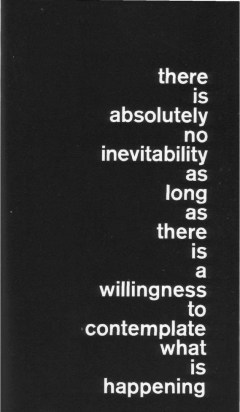
Marshall McLuhan and Quentin Fiore (1967) The Medium is the Massage: An Inventory of Effects, 25. Produced by Jerome Agel. Corte Madera, CA: Ginko Press, 2001. Marshall McLuhan – The Medium is The Massage.pdf (PDFy mirror), 17. Uploaded July 27, 2014, Internet Archive. Accessed March 1, 2018, https://archive.org/details/pdfy-vNiFct6b-L5ucJEa.
Though, while many librarians have discovered that adaptability to an environment of constant flux is in our own best interest, if we want to remain relevant, how many of us really get to do anything more than respond daily to immediate tasks and needs? We’re often already saturated, and incessant disruption and change can contravene innovation, the development of projects, smooth workflows, and more than sufficient progress towards achieving objectives.
The key is suggested in the second half of the McLuhan quote. Although to “march backwards” does seem to imply proceeding blindly as it were, it is probably also meant to convey steady forward movement that is accomplished alongside and in sync with others, and perhaps more importantly since we are moving backwards the rear-view mirror gives us glimpses of the future not the past.
Either way, to interpret the here and now we need to vigilantly monitor the changes in our situation, and realize we are never alone even as we go progressively onward. A wonderful current example of this is how EDUCAUSE is picking up the pieces of NMC and has pledged to continue producing Horizon Reports. A real impediment is heel-draggers who simply commiserate as they impede the organizational trajectory with pessimism while things simply change around them and others try to rocket by.
Perhaps McLuhan’s diagnosis of the phenomenon of considering where we’re headed in relationship to the past and present is the silver lining to the customary performance review cycle, which is presumably culminating for many of us right now. Real professional growth requires we take the time to celebrate successes and evaluate failures before moving onto the next thing. We also need to take time to assess with colleagues and supervisors along the way, not just once a year.
Otherwise the annual appraisal is dreaded, the mission statement is mere marketing, staff development becomes extracurricular, goals are nothing more than quickly forgotten new year’s resolutions, and the strategic plan is just a dust collecting showpiece. Besides, going “into the future” together is inherently more optimistic because each of us has glimmers to share during the journey, if we take the time to gaze regularly into our rear-view mirror.
A Quick and Easy Assessment Tool: Socrative
Assessment. What comes to mind when you heard that word? Dread? Fear? A vague sense of unease? We all know it’s important, and we all know it’s really hard to work into instruction, especially if it’s a one-shot session. For me, the dread I felt related to assessment was exactly that: the feeling that I needed to fit this really important and time consuming thing into the little time I had with each class. There is so much to cover, and taking time to do a pre-quiz and post-quiz, or any other in depth assessment, detracts from valuable time spent on information literacy concepts and skills. To alleviate this time crunch while still getting valuable feedback from students, I’ve started relying on quick and easy interactive tools like Socrative to gather assessment at the end of each one-shot instruction session.
Socrative.com is a free (for non-premium access) classroom app that allows a user to create quizzes, exit tickets, and other interactive engagement techniques. Instructors have a teacher login to set up quizzes before class, then activate the quiz either before class or as needed during the class period. Students navigate to the Socrative student page, login with a room name, and answer a few questions to provide instant feedback to the instructor.
Because I try to spend as little of the class period as I can on assessment, I take the last two minutes of the class period to ask students to do one last thing before they head out. In my pre-class prep, I have already launched an assessment and activated a new room. At the end of the period, I ask students to enter the room name (I’ve found it easy to make the room the name of the class I’m working with, i.e. ENGL15), at which point the self-paced “quiz” begins.
I designed a basic quiz that works for the majority of my freshmen level classes. If I’m working with an upper level class, I create a quiz with more targeted questions. In the basic assessment, students first answer a Likert scale question about how well they understood the material presented. The next two responses are free type fields. They’re asked to give a response to one thing they learned during our session, and finally they wrap up with a short answer asking one thing they’d like to know more about. While I’d like to be more reflective on concepts covered during our instruction session, I’ve decided that for now, these quick and easy answers are useful for me to take into account for planning future classes.
One of the best parts about Socrative is how easy it is to get to the students’ feedback. After each student has answered their three questions, I end the room session and have the results emailed to me in an Excel spreadsheet. The feedback I’ve received from students has been helpful in learning what worked and what did not work, and is also interesting to look at with similar classes compared over the same semester. It helps me reflect on what I’m doing that goes over well, which is sometimes more related to my energy level on a particular day than how a concept was presented and reinforced.
Possibly because I don’t require them to use their names, the students are quite honest with me about their level of understanding. When I first started using Socrative, I thought I’d get a lot of nonsense responses, especially in the free type fields. I’m happy to say that rarely happens; most students are thoughtful while providing feedback. I’m also honest with them that their responses will help inform me what to talk about with classes like theirs in the future. This might be another reason that they are engaged and open with this quick assessment tool.
Of course, in an ideal world, we’d each be able to work with instructors to perform complete assessments before, during, and after library instruction. Reality doesn’t often allow that, though, which is why using an easy tool like Socrative is helpful in maintaining a grasp on assessment in library instruction.


 It's Academic