Social Capital
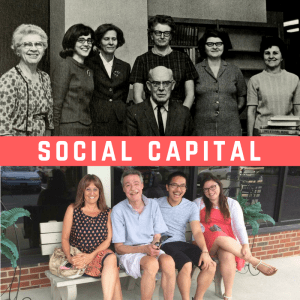 While it’s great to highlight library services and collections, it is called “social” media for a reason. At Bishop Library we’ve found that audiences want to learn and relate to people in the library. Sure you may have spent hours making the perfect Canva ad highlighting a library event, but you will most likely get far more feedback spotlighting people. Not all staff are up for this, but most are willing to participate and enjoy the attention. We’ve tried to highlight staff with short biographies, interests and fun facts.
The best part this is often an easy thing to do ahead of time and with a small staff this is crucial. We use the social media management platform Hootsuite to schedule out as many posts as possible.
Highlighting staff members during national or college-wide events draws attention from alumni and current members of the college community. Your post or tweet may also be shared by the college and wider audience. Staff member Becky Chanas’ unique shirt (in the Instagram post seen here) on election day was a hit on Instagram.

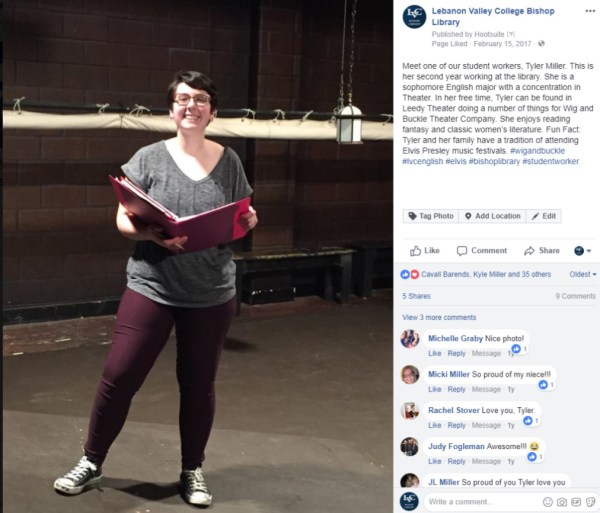
If you have student staff members this is a perfect way to connect to your student workers’ social capital. We created a series of posts spotlighting student workers. The example below of student worker Tyler Miller was scheduled to be posted on the opening night of the college theatre group’s production of A Midsummer Night’s Dream. Not only did this create more engagement and comments than a typical post it also gained us some new followers.
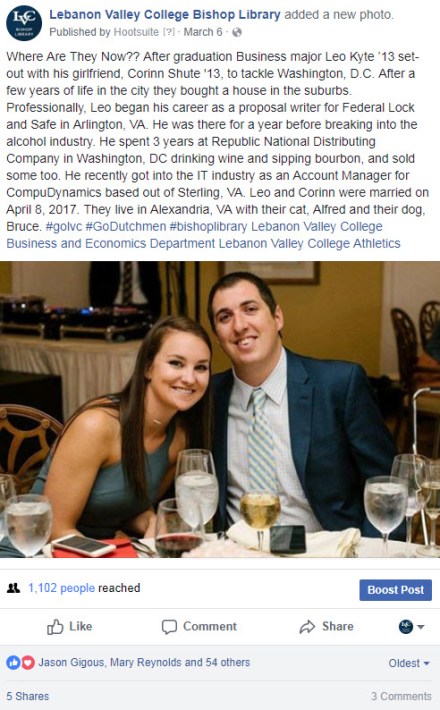
Also don’t underestimate the power of your alumni. Working off the momentum established with student worker profiles, we reached out to former library student workers for a “Where Are They Now?” posts. The majority of former student workers reached out to responded within a few days with a photo and short update on their lives, leaving just editing and scheduling for me to do. I worked hard to tag all their respective departments and former student activities in the posts. Former student worker Leo Kyte, seen here with his wife Cornin (also an LVC grad), created the most buzz we’ve seen from this series of posts.
So when in doubt on what to post, leverage the appropriate social capital (including your best friend’s sister’s boyfriend’s brother’s girlfriend) and reap the rewards.
Photo credits in order of appearance.
- Lebanon Valley College Archives. “Library Staff.” Quittapahilla Yearbook, Internet Archive, 1969, https://bit.ly/2Ll3tFj.
- Bentz, Maureen. “Library Staff Catching Up and Keeping Cool.” Facebook, 2017, https://bit.ly/2JpoxgD .
- Bentz, Maureen. “Meet our Library technician, Becky.” Instagram, 2016, https://bit.ly/2kLChV7.
- Miller, Tyler. “Meet One of Our Student Workers, Tyler Miller.” Facebook, 2017, https://bit.ly/2sv0XWi.
- Kyte, Leo. “Where Are They Now?? After Graduation Business Major Leo Kyte ’13 Set-out with His Girlfriend, Corinn Shute ’13, to Tackle Washington, D.C.” Facebook, 2018, https://bit.ly/2LlrwUD.
BUDSC18 Extends Call for Proposals
Bucknell University will host its fifth annual digital scholarship conference (#BUDSC18) from October 5th-7th. The theme of the conference is “Digital Scholarship: Expanding Access, Activism, and Advocacy.”
#BUDSC18 will bring together a community of practitioners–faculty, researchers, librarians, artists, educational technologists, students, administrators, and others–committed to promoting access to and through digital scholarship. We consider “access” in the broadest possible terms: accessible formats and technologies, access through universal design for learning, access to a mode of expression, access to stories that might not otherwise be heard or that might be lost over time, access to understanding and knowledge once considered beyond reach.
We encourage proposals that explore or critique digital scholarship as it relates to access, broadly conceived. Topics may include, but should not be limited to, the following:
- Accessibility of digital platforms and technology
- Access to resources to engage in or produce digital scholarship
- Digital scholarship and social change
- Sustainability and future access to digital scholarship
- Digital scholarship and multimodal/interdisciplinary access
- Access to digital scholarship beyond the academy
- The public mission of digital scholarship
- Creating opportunities for diverse voices and perspectives
- Designing for access, activism, and advocacy
Submissions may take the form of interactive presentations, project demos, electronic posters, panel discussions, work-in-progress sessions, workshops, lightning talks, or other creative formats.
We look forward to building on the success of the last four years, in which we have come together to discuss challenges, share working models, reflect on projects, and inspire new avenues for actively including students in public scholarly pursuits. For more information, please view our highlights from the 2017 meeting, the conference website and this year’s call.
Proposal Submission Form: https://goo.gl/forms/4nVllpVvaLEW9Jc02
Proposals are due: June 30th, 8:00 PM, Eastern Time (US).
Notifications will be sent by the end of July.
If you have any questions please contact: budsc@bucknell.edu
Dive In
 During the summer of 2017, the last thing I wanted to do was start another social media channel. However, my director kept discussing Tumblr and it was obvious she thought the demographic (18-29 year olds) interested in Tumblr would be a good fit for our library. As a Gen-Xer, I had no personal experience with Tumblr. When I looked into it, I still didn’t really understand it (and maybe still don’t). To me it was a micro-blogging platform with a visual focus, but what was the point?
After some in-house discussion, we decided to give our archival student worker the freedom to share her opinions and thoughts about archival photos and objects. She dove into the project during the quiet summer months. Once completed, I reviewed each of her posts to correct and edit them for spelling and grammar. Additionally, I corrected any misinterpretations or historical inaccuracies. Our student did an amazing job finding items that were engaging. She crafted and scheduled out (via Tumblr’s queue feature) posts for the entire year. With the help from another staff member, she also took some great photos of some rarely seen objects.
To spread the word we followed other Tumblr accounts (194 in total) and used our other social media channels to cross promote our Tumblr posts. After a year we have 1051 followers and 430 notes/likes. So what is the point? For us, Tumblr expanded the college-age audience of our archival materials and showcased them in a way that was conversational, not authoritarian. With limited staff, our archives have no regular open hours. Tumblr offered a great way to showcase some of our more visual items to a wider audience.
Given the encouraging jist of the title of this post… “Dive In,” don’t be fooled. I am currently dragging my feet on Snapchat. This morning I spoke with student workers who made a case for the social media channel and suggested uses, but with my limited experience I’m still apprehensive. Eventually, I will dive in, but right now I’m thinking about testing the waters.
Lebanon Valley College Archives on Tumblr https://lvcarchiveblog.tumblr.com/
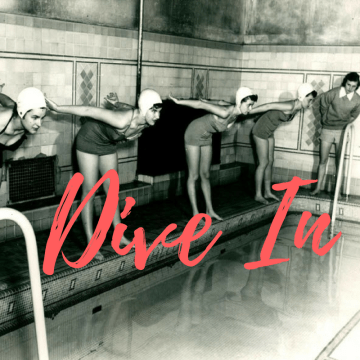
(Photo credit: Lebanon Valley College. “Women Swimming.” Student Affairs-Women’s Sports, F4.2, 2015.06.1337, Lebanon Valley College Archives Photograph Collection, 1954, Annville, PA).
Extra, Extra, Read All About It
Learning the whereabouts of family members and loved ones was one of the earliest acts of freedom undertaken by African American slaves who were liberated by The Emancipation Proclamation issued by President Abraham Lincoln in 1863.

Information Wanted Ad, The Freeman (Indianapolis, IN), March 31, 1894, Accessed from Last Seen: Finding Family After Slavery.
The vehicle of discovery was notices placed in newspapers as advertisements under the heading “Lost Relatives” or “Information Wanted.” Historian and Villanova University professor Judith Giesberg, PhD, began a process of unearthing these ads using microfilmed newspapers. Because of this initiative, and others like it, Villanova University’s library recently increased its access to diverse and historically significant newspapers and periodicals in digital format. Last Seen: Finding Family After Slavery as a digital humanities project has blossomed and gotten media attention.
- “‘Information Wanted’: Freed slaves’ heartbreaking ads tell personal stories of slavery,” CBS Evening News
- “After Slavery, Searching For Loved Ones In Wanted Ads,” National Public Radio
- “Families torn apart by slavery sought lost loved ones in newly archived ads,” Philadelphia Inquirer
When working with newspapers researchers quickly realize most content is not free. Our library buys access to the Philadelphia Inquirer (1981- present) and many other newspapers via NewsBank and other databases like “America’s Historical Newspapers: 1690-1922” from Readex. Other major sources of newspaper content that we have are ProQuest Historical Newspapers, Nexus Uni, and Accessible Archives.

Article Headline, Catholic Transcript (Hartford, Connecticut), Volume LXVIII, Number 31, November 26, 1965, Accessed from The Catholic News Archive.
As critical as these costly options are, librarians should not neglect their “step-sisters.” Web-based portals with free open access to newspaper content which are incredibly valuable to scholars, such as:
- The Catholic News Archive, from Catholic Research Resources Alliance (CRRA): https://thecatholicnewsarchive.org/
- Chronicling America: Historic American Newspapers, from the National Endowment for the Humanities and the Library of Congress: https://chroniclingamerica.loc.gov/
- History Unfolded: US Newspapers and the Holocaust, from the United States Holocaust Memorial Museum: https://newspapers.ushmm.org/
- Virginia Gazettes: Williamsburg Newspapers from 1736 to 1780, from Colonial Williamsburg: http://research.history.org/DigitalLibrary/va-gazettes/
Large and small, these mostly niche digitization projects are resources librarians will find invaluable and libraries should support. For a robust listing of newspaper digitization projects visit the International Coalition on Newspapers (ICON) Webpage on the Center for Research Libraries: Global Resources Network site.
C&CS Presents: Transparency in the Tenure Process
C&CS Presents
Transparency in the Tenure Process:
A Frank Discussion on Earning Tenure and Thriving as an Archivist in Academia
June 21, 2018 — 1 pm
Register here for the Zoom Link!
Many archivists are in positions that require them to publish, present at conferences, apply for grants, and serve in organizations to move forward at their institutions. This webinar will highlight three panelists, all in various stages of the promotion and tenure process, who will be transparent and frank in their discussion of how to navigate the academic system. The discussion will include practical tips for curating a research agenda, strategies for shining in yearly reviews, and advice for those applying to tenure-track positions. Join Elizabeth, Rachel and Heidi discuss these aspects to prepare archivists in all stages of the tenure process to be better equipped organizationally and have a clearer understanding of expectations and challenges.
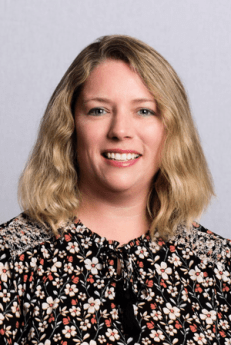
Elizabeth M. Scott is currently the Archivist & Special Collections Librarian and Assistant Professor at East Stroudsburg University in Pennsylvania. She is the liaison for art+design, theatre, health studies, exercise science and athletic training. Prior to coming to ESU, she worked as an archivist in various states including Massachusetts and Arizona. She is actively involved with the Academy of Certified Archivists and the Mid-Atlantic Regional Archives Conference organizations. Her research interests include art and archives as well as archivists in academia. In her spare time she enjoys mentoring new archivists in the field and reading fiction books
Rachel Walton is a junior faculty member and the Digital Archivist and Records Coordinator at Rollins College, a private liberal arts school in Winter Park, Florida. In that role she works to acquire, preserve, and  provide access to the college’s digital assets. Rachel also serves as the liaison to the Art and Art History Department, acts as the college’s record management expert, and supports digital humanities projects across campus. Her research interests include website usability, oral history, and data management planning. She is an active member of the Society of American Archivists and Chief Editor of the Society of Florida Archivists Journal. When she’s not working Rachel likes sipping cappuccinos, playing with her adorable French Bulldog, and getting out in the Florida sunshine.
 Heidi Abbey Moyer is the Archivist, Humanities Reference Librarian, and Coordinator of Archives and Special Collections at the Penn State Harrisburg Library in Middletown, Pennsylvania. She is also a tenured faculty librarian with the Penn State University Libraries. Her research interests are interdisciplinary and focus on American popular culture, especially motherhood and weddings, archival advocacy, primary source literacy, and outreach, as well as museum studies. Ms. Moyer has published in the peer-reviewed journals Art Libraries Journal and Archival Issues, and recently contributed to the book Women’s Rights: Reflections in Popular Culture (ABC-CLIO, 2017). During her first post-tenure research sabbatical, she completed her second book, Penn State Harrisburg (Arcadia Publishing, 2016), which is a celebration of the college’s 50th anniversary. Currently, she is working on two new books, one that focuses on the diabetes epidemic and its influence on American fertility, food, and popular culture, and another one that will highlight Mount Gretna, Pennsylvania’s Chautauqua. Aside from her obsessions with history and research, she enjoys watching movies with her husband and three sons, creating a pollinator-friendly garden, painting, meditation, and yoga.
Zoom link will be sent about 2 days before the session.
Thanks!


 Adam Balcziunas
 Alex K.
 Alexandrea Glenn
 Andrea Pritt
 aprilnkelley
 Ashley Purvis
 Bethann Rea
 blj13
blj13 Brendan Johnson
 Amanda Boyer
 Bret Stiffler
 Bonnie Powers
 Christopher Lemery
 clarewithers
 clblibrarian
 Kelly Clever
 Charlotte M. Johnson
 colemanluzerne
 CRD of PaLA
 crdvirtualjournalclub
 cre5314
 csgarth
 Erin B.
 danajkerrigancv
 denisewetzel1
 Darren G. Poley
 elm43
elm43 James D'Annibale
 Annie Jansen
 Jill Hallam-Miller
 jennifercribbs
 Jenn Monnin
 Jen Hasse
 Jessica Showalter
 johnmeier1
 Kelly Safin
 Kim Karim
 Kristen Seikaly
 Kayla Van Osten
 Cecelia Lasley
 librarianjsmith
 Linda Neyer
 mabogino1
 Matthew McNelis
 Meg Massey
 Maggie Savidakis-Dunn
 Rebecca
 miskatoniclibrarian
 Maureen Bentz
 Michele G. Anfuso
 Nicole Miyashiro
 paulmcmonigle
 Rob Sieczkiewicz
 ronlmccoll
 Sam Bardarik
 shannahollich
 smartin592
 Ula Lechtenberg
 It's Academic