CRD Conference Corner Volume 5
With only two days away from PaLA’s annual conference we will take one last look at sessions being sponsored by CRD this year. These sessions revolve around the idea of the librarian as more than just a keeper of knowledge, and discuss how a librarian can be at the front of social activism, community service and campus inclusion.
Title: Unpeeling the Onion: Using Participatory Design Processes to Discover First Generation Students Experiences Using the Library
Presenters: Hailley Fargo, Student Engagement & Outreach Librarian, Penn State University, University Park
Steve Borrelli, Head of Library Assessment, Penn State University, University Park
Carmen Gass, User Services Training Coordinator, Penn State University, University Park
Elpidio De La Cruz, Student, Penn State University, University Park
Abstract: The University Library strives to make the library a place for everyone by keeping diversity and inclusion at the forefront of research and services. Intrigued by results of a 2016 Ithaka study of undergraduates which showed differences in use and perceptions of library services and resources of first generation students at Penn State University, researchers conducted a case study investigating the library experiences of first-generation students at the University Park campus. During the spring 2018 semester, researchers used a participatory design approach called “gamestorming” with a group of six first-generation students to discover their experiences in the library. Gamestorming is an approach where design activities are used to ideate through game play. The process allows for a group to get to know one another by first developing trust, then working together through the challenge space, discovering problems along the way. The process ends with evaluating ideas surfaced during the process. This presentation will describe the process of gamestorming, share results, insights, and lessons learned from this study, highlight the student experience from one of our first-generation student participant-researchers, and will give the audience a chance to try out a gamestorming activity that could be used with their library community.
Time: Tuesday, October 16th 2:15pm-3:30pm
Title: Bringing the Critical Librarianship Movement into the Classroom
Presenter: Samantha Bise-Schultz, Reference & Instruction Librarian, Central Penn College
Abstract: Have you heard of the Critical Librarianship movement and want to know what it’s all about? Are you part of the conversation already, but don’t know how to turn theory into practical instruction activities? Find out how librarians are linking their work as information literacy educators to social activism. Attend this session for a brief introduction to critical theory as it relates to librarianship and information literacy, suggested resources to get you involved in the Critical Librarianship conversation, and various critical instruction methods and activities. The presentation will be followed by a guided group discussion on ways librarians can turn critical librarianship theory into action to engage students as creators and users of information.
Time: Wednesday, October 17th 9:00am-10:00am
Title: What do Libraries Have To Do With the YMCA, Humane Society, Fair Trade, and Undergraduate Research?
Presenters: Jen Jones, Associate Professor and Department Coordinator, Communication, School of Business, Seton Hill University
Theresa R. McDevitt, Government Information/Outreach Librarian, Indiana University of PA Libraries
Amy Podoletz, Undergraduate Student, Communication, Seton Hill University
Abstract: New teaching practices, such as experiential learning and service-learning, are becoming more and more important on college campuses. This pedagogical approach leads to improved understanding and ability to apply theory, and also growth in areas like acceptance of diversity, increased compassion and caring for others, self-confidence, and growth in social responsibility and civic engagement. This session begins with win-win stories, written by librarians, university faculty and students who have successfully employed service based or experiential learning experiences for students in higher education. In each case, the course or educational event developers have intentionally included service to a partner, real work applications of theory, mutual benefit for all involved, and opportunities for thoughtful reflection. Presenters will describe activities, motivations, curriculum materials, and outcomes in enough detail to assist others in building upon their experience to bring this positive practice to their institutions. Participants in the session are then invited to share their own success stories in a welcoming and creative environment.
Time: Wednesday, October 17th 10:15am-11:30am
Space Renovations on a Budget
“Had we but world enough… and time” – the oft quoted line from Andrew Marvell’s “To His Coy Mistress” can often be followed with “and funding”. In an era where many academic libraries are faced with staffing and budget constraints, we’re faced with the challenge of doing more with less. Perhaps one of the biggest challenges we encounter is space. Library spaces get taken over by other departments; as student populations evolve, so do their needs for space. Renovating and creating spaces on a shoestring budget can be achieved!
I am the Director of Library Services and College Librarian (my two official titles among the many other hats I wear) at Valley Forge Military Academy & College’s May H. Baker Memorial Library. While we are frequently complimented on how beautiful our building is, we have also become acutely aware of the challenges of providing 21st century library services in a facility that was designed and constructed in the 1960s-1970s. Yes, major renovations, such as upgrading the IT infrastructure are also necessary, but there are also smaller ways to achieve tangible and visible results relatively quickly, and relatively cheaply.
Here are some tips that have worked for us:
TIP: Assess the current space usage and needs. Our library has historically been for group study, as individual work was encouraged in the barracks (dorms), so our seating is primarily for large study groups (6-8 person tables).
TIP: Use Participatory Design methods to get input from key stakeholders. We found the students wanted the ability to work individually.
TIP: Use resources already available – in the library – on campus – or locally. Move furniture around – think of supervisory challenges, what students tend to do in different locations of the library. We found a bunch of old individual computer desks, and instead of having them occupy a classroom, we moved spread them out on the upper level of the library – strategically placing each desk (that has its own power supply) by one of our balcony pillars – in an IT upgrade, data drops were added as well – there are now desktop computers available spread throughout the library instead of just in a lab (that’s often booked for instruction).

TIP: Leverage Donations.
- Because our institution is non-profit with strong community partnerships, we keep in the loop about local businesses and schools upgrading or closing, and are able to procure donations of gently used furniture and equipment. Rather than spend money on a conference table for my office, I was able to find a kitchen table and chairs FOR FREE (Offer Up, Let Go, and Facebook Marketplace are great places to look) to serve the purpose, and provide the relaxed atmosphere I was aiming for to help make students comfortable.
- TIP: Have
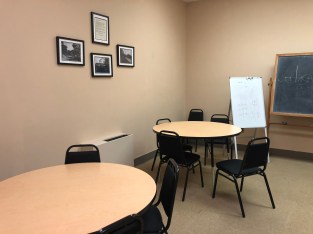 a wishlist for things you want for your library; you never know when you’ll be approached by a potential donor! When asked what the library needed, my reply was “space”. We had discovered an old periodicals room that had grown to also become a dumping ground across campus – an entire, existing room, with a lockable door that could easily be used for small group instruction, tutoring, club meetings, etc.! We set about clearing out the space, and our donor funded the purchase of new furniture (group study tables and chairs). Our donor also helped us to name the space, in memory of an old building no longer standing on campus, adding to our institutional history.

TIP: Make a plan for the library to use the space before weeding to create open space… if there is open space just sitting, it will most likely be occupied before a plan is created for it. We knew that we would be able to spend a portion of our budget on individual study carrels, so we planned out where we wanted them, weeded, and shifted books, allowing us to remove two large sections of shelving to make room for the study carrels.
While it may take a little bit of time, and some creativity, it’s completely possible to renovate and repurpose library spaces on a budget!
Image credits: Dana J Kerrigan, Director of Library Services and College Librarian, Valley Forge Military Academy & College
CRD Conference Corner Volume 4
 We are only one week away from the PaLA annual conference, and in this edition of the Conference Corner we will take a look at sessions that focus on source usage, international student retention, and learning commons – oh my!
Title: Information Overload!: Assessing Source Usage in Students’ Reference Lists.
Presenters: Kristin E. C. Green, Reference and Instruction Librarian, Penn State Scranton
James Hart, Lecturer in Communication Arts and Sciences, Penn State Scranton
Abstract: Instruction librarians spend significant amounts of time planning lessons by collaborating with the course instructor and aligning information literacy outcomes with the instructor’s learning outcomes. Often times for general education courses, information literacy sessions include introducing that ideal database or two for specific research assignments. But once that instructional time is over, do students apply what they learned or do they revert to unsavory research habits developed over the course of their academic lifetimes? This session will initiate conversation around this question by using data generated from analyzing students’ reference lists. The course in which this overarching assessment was conducted, Effective Speech, is a general education course that all undergraduate students are required to take at Penn State. The instructor assigns three speeches during the course of the semester that require background research. All sections of this course have a oneshot information literacy session in which two databases are introduced as ideal resources for garnering the background information needed for the students’ speech topics. The data was gathered in the Spring 2018 semester from three different class sections. As co-presenters, the librarian and instructor will discuss their teaching collaboration, explain their analytic process, and share preliminary findings.
Time: Tuesday, October 16th 9:00am-10:00am
Title: Libraries as Partners in International Student Retention: How Programming and Outreach Impact Sense of Belonging
Presenters: Emily Mross, Business Librarian, Penn State Harrisburg
Joi Jackson, Reference and Instruction Librarian, Penn State Harrisburg
Abstract: In 2017, Pennsylvania’s colleges and universities enrolled 51,129 international students, ranking sixth in the nation for total international enrollment, and academic libraries now serve a growing population of international students. In addition to meeting the educational and research needs of international students, college and university libraries should also meet their social needs. Through outreach that fosters relationships between international and domestic students, the campus library can serve as an academic and social hub that contributes to a sense of belonging that is vital to international student retention. Attendees will learn why belonging is critical for the perseverance of international students and will discuss strategies for nurturing belonging in their libraries and on their campuses. Presenters will detail successful programming and outreach initiatives from their campus, and how these events improve relationships between international and domestic students through facilitated interaction. Participants will discuss campus contexts, current programs, and ideas for future programming.
Time: Tuesday, October 16th 11:00am-12:00pm
Title: The Library is Open: Pragmatics and Possibilities for a Commons Oriented Future
Presenter: Robin DeRosa, Professor of Interdisciplinary Studies; Director of Interdisciplinary Studies, Plymouth State University (MA)
Abstract: In this keynote presentation, Robin DeRosa will explore libraries as architectures of hope that gesture toward a commons. In an era where privatizing forces threaten to wall off and commodify knowledge, Robin will offer a vision of libraries as an intrinsic part of a public infrastructure for learning and research. By invoking both the work that happens inside and around libraries and the communities that libraries engender, Robin will frame a conceptual and aspirational theory of libraries and posit concrete practices that can help our society understand libraries as integral stewards of the public good.
Time: This is the the keynote presentation at the College & Research Division Luncheon on Tuesday, October 16th
Free Workshop for Members
Register now for the Southwest Chapter’s annual Fall Workshop–designed for support staff but open to all! FREE to PaLA members!
https://www.palibraries.org/event/

Finally entering the academic library world!
It is with much enthusiasm that I share the good news with the CRD: Later this month, I will be starting my first professional job as an academic librarian! While it is part-time (27.5 hours per week), I will be an Information Services/Interlibrary Loan Librarian with Lehigh Carbon Community College’s Rothrock Library. I cannot tell you how over the moon with joy I am at finally landing this position. It has been a long, and I do mean long, tedious road of interview after interview with various higher education institutions strewn throughout southeastern Pennsylvania. With this job, I hope to be able to contribute more to the PaLA CRD blog since I will be in an academic library.
In addition to this job, I will also keep my current position as a library assistant at Lower Macungie Library, which is a public library. I am excited to be a part of the two worlds and to see where they overlap and where they completely differ. It is going to be a unique set-up for me and I honestly cannot wait to start. I look forward to sharing with you the new horizons I will experience at Rothrock Library!


 Adam Balcziunas
 Alex K.
 Alexandrea Glenn
 Andrea Pritt
 aprilnkelley
 Ashley Purvis
 Bethann Rea
 blj13
blj13 Brendan Johnson
 Amanda Boyer
 Bret Stiffler
 Bonnie Powers
 Christopher Lemery
 clarewithers
 clblibrarian
 Kelly Clever
 Charlotte M. Johnson
 colemanluzerne
 CRD of PaLA
 crdvirtualjournalclub
 cre5314
 csgarth
 Erin B.
 danajkerrigancv
 denisewetzel1
 Darren G. Poley
 elm43
elm43 Heather Burychka
 James D'Annibale
 Annie Jansen
 Jill Hallam-Miller
 jennifercribbs
 Jenn Monnin
 Jen Hasse
 Jessica Showalter
 johnmeier1
 Julie Durci
 Kelly Safin
 Kim Karim
 Kristen Seikaly
 Kayla Van Osten
 Cecelia Lasley
 librarianjsmith
 Linda Neyer
 mabogino1
 Matthew McNelis
 Meg Massey
 Maggie Savidakis-Dunn
 Rebecca
 miskatoniclibrarian
 Maureen Bentz
 Michele G. Anfuso
 Nicole Miyashiro
 paulmcmonigle
 Rob Sieczkiewicz
 ronlmccoll
 Sam Bardarik
 shannahollich
 smartin592
 Ula Lechtenberg