CRD Conference Corner
 With PaLA’s annual conference rapidly approaching we here at It’s Academic! want to shed some light on the upcoming conference sessions that CRD is sponsoring. We will be devoting some space to each program over the next five weeks, and if you read something you like make sure to check out the session at the annual conference! We will lead off this series with a session focusing on collaboration across colleges and the support of at-risk first-year students.
Title: Teamwork Makes the Dream Work: Inter-College Collaboration Using IL Instruction to Support At-Risk First-Year Students
Presenters: Christine Iannicelli, Instructional Technology Librarian, Ursinus College
Diane Skorina, Director of Research, Teaching & Learning Services, Ursinus College
Ronalee Ciocco, Director of Library Services, Washington and Jefferson College Samantha Martin, Research & Collections Librarian, Washington and Jefferson College
Abstract: Librarians from five colleges, funded by an Institute for Museum and Library Services Sparks! Ignition grant, collaborated to develop an information literacy instruction program based on the ACRL Framework for Information Literacy for Higher Education. The project was designed to investigate the impact of information literacy instruction on the success and persistence of at-risk first year students. Representatives from the institutions will report on how they collaborated with experts and each other to develop the instructional activities and assessments and build partnerships with faculty. They will also present the research findings and their goals going forward. Presenters will then facilitate discussion around potential collaborative efforts inspired by the Framework.
Sunday, October 14th 2:30pm-3:45pm
Digital Scholarship: Wherefore Art Thou Libraries?

Scholarly output today is not just text anymore. This statement may now seem axiomatic. If it is, however, libraries cannot afford to simply acknowledge it; they must embrace it. But not every library has access to all the latest tools for enabling digitally-oriented research, much less the capacity for such things as developing mobile apps designed to aid meta-analysis or to disseminate big data visualizations. What every library does have is the ability to consider the range of its activities, to ask what makes the most sense. Is it OA publishing? Is it makerspaces? What’s the scope of the disciplines to be served? Whose involvement is required?
A first step can be to begin a conversation around emergent forms of scholarly communication. Next discuss what service nodes should your library provide: teaching & learning, technology & tools, and/or spaces & expertise. Then decide what resources need to be redistributed so that your library can meet the digital scholarship needs of the community you serve. And keep asking throughout: What do we want to do and why are we doing it? You may be community building by bringing disparate pockets of scholars together in new and interesting ways, or simply facilitating collaboration that exists to do more. Ongoing honest needs assessment is necessary.
Some libraries provide consultation services. Others host workshops and events. While still others build cyberinfrastructure for digital curation and preservation. There is no one correct path for every library when it comes to supporting digital scholarship. Examining what you have and what you do is critical. While simply ceding space, without committing some library involvement is a mistake.
It is essential to explain what you have and what you do. Be sure to keep a public list of activities or project involvement. Be clear about the relationship between mission and priorities. Be certain to foster stakeholder champions. Interest cannot be conjured. It needs to be intentionally fostered. Always be ready to answer the question: Why the library?
Here are a few nascent responses. If the mission of the library is to support research and promote scholarship, then today that must include e-research and digital scholarship. If the library is for everyone, then a culture of technical expertise is required given the pervasiveness of technology in our society, and not just electronic computing but even virtual reality. If we are to prepare our users for an increasingly globalized knowledge base, economy and ecosystem, then we must immerse ourselves and invest in shaping competencies and instilling best practices.
The entrée for a lot of libraries is still digital humanities. Some may still be mystified because the match seems star-crossed, and yet libraries cannot afford to ignore the signs. One short report that may help is “Building Capacity for Digital Humanities: A Framework for Institutional Planning” (https://library.educause.edu/resources/2017/5/building-capacity-for-digital-humanities-a-framework-for-institutional-planning).
We Are All Founders
Seton Hill University is observing its Centennial this year. Although the origins of “the Hill” date back to 1885, 1918 was the year that it became a college. Prior to that there were various educational institutions – an academy, junior college, and conservatories of music and art. There have been many events to celebrate this milestone, including the stories of our founders and their history. However, at our Fall Workshop to open the current semester, the Provost stated, that although we look back to the Sisters of Charity who began the work here, in a sense we are all founders. We all bring our own gifts and talents to further the mission of the University.
This led me to reflect on my own time here and I wonder if this is something that all of us should do at our institutions. It is so easy for us to become isolated and not see ourselves as part of the bigger picture. Institutions should not be static, but instead should be evolving.
Sr. Francesca Brownlee, a previous directress of Saint Joseph Academy and the “guiding spirit” and tireless foot soldier in the effort to move Seton Hill from secondary school to college, was named dean of the college in 1919, a position in which she served until 1929. Sr. Francesca is widely believed to be the author of an article in the 1919 Seton Hill Bulletin that contains a directive, which became one of the school’s guiding principles:
“If the management of Seton Hill find a way of doing things that is better than their present method they will replace all of that method or any part of it without scruple, for they are bound by no traditions and they fear nothing but God’s disfavor and the closed mind.” Seton Hill Then and Now (1919)
Rather than just furthering the mission of the library, I should want to help shape the future of the entire university. So far, I have been able to do this in several ways:
- When choosing committee service, I try to select areas that are not directly related to my position, but which serve the university as a whole. This helps me to be part of the bigger picture.
- When participating in program reviews, I don’t just provide information on library resources, but attend all meetings and contribute to other areas of the review.
- In addition to the usual LibGuides for patrons, I have created guides on St. Elizabeth Ann Seton, Catholic Social Teaching, and the Catholic Intellectual Tradition. I have also created a private LibGuide for our Board of Trustees. This is helpful because although we are a Catholic institution, many of our students, faculty, and staff are not Catholic. This helps everyone to understand the foundation of our history and mission.
In a more intentional way, I plan to find other means in the future to continue to be a “Founder.” I think that this will also help me to be a better librarian.
Six ways your library can support a Common Read program
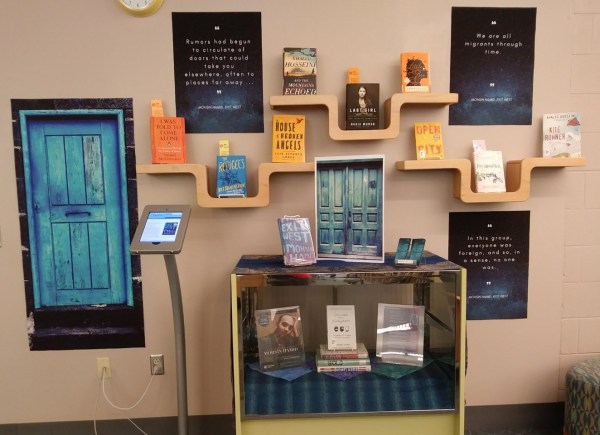
The Penn State Altoona Library’s display promotes the 2018-2019 Common Read novel, Mohsin Hamid’s Exit West.
Libraries can serve as vital partners for a Common Read program. This opportunity allows librarians to contribute to a campus-wide initiative, bring the community together, and support student success, engagement, and retention.
Common Read programs (also called One Book, Campus Read, Summer Read, Common Reading Experience, etc.) encourage members of the university community to read the same book. Sometimes the programs focus on first-year students, while others are campus-wide. Many Common Read programs feature events such as discussions, performances, or exhibits related to the book. Faculty often incorporate the book into their courses as well. At some institutions, the library sponsors the program; at others, the program is run by a department or committee and the library serves in a supportive role.
Some ways that libraries can support a Common Read program include:
- Book selection. Librarians can join the Common Read selection committee, suggest titles, or provide reviews of short-listed books.
- Programming. The library can make available space for events, or librarians can serve as panel participants. They can publicize these events on the library’s social media channels.
- Display. Libraries can host a display or exhibit to promote the Common Read book. Displays might include related books, films, or other resources; printed promotional materials; and interactive multimedia aspects.
- Instruction. Many librarians are involved in providing information literacy instruction for first-year seminars or English composition courses. Consider using examples from the Common Read in these instruction sessions.
- Reserves. Librarians can place copies of the book on reserve for patrons who might have financial constraints if the book is not distributed freely.
- LibGuides. Librarians could create an online guide that includes bibliographies of related resources, book reviews, links to author pages and interviews, and a schedule of events.
For example, Penn State Altoona has been running a Common Read program since 2013. For the 2018-2019 Common Read, the book selected is Moshin Hamid’s novel, Exit West. Incoming first-year students received free copies of the novel at orientation, and several faculty have incorporated the book into their syllabi. As part of the program, the campus is offering a full schedule of events including a film screening, panel discussions, writing workshops, culinary presentation, and writing contest, capped off by a keynote address by the author. To support the initiative, the library created a display (pictured above) featuring the book and related materials, posters and bookmarks with quotes from the book, and an iPad pre-programmed with links for more information about Common Read events, the author, and read-alikes. In addition, the library will publicize the Common Read on its social media, and the novel is on reserve for interested patrons who did not yet receive a free copy.
For more ideas about supporting your Common Read program or even for starting one of your own, check out the ALA’s “One Book” webpage. It offers a detailed guide for planning a Common Read program, as well as a list of 150 similar programs from libraries across the US that could serve as models or inspiration.
Jessica Showalter is an Information Resources and Services Support Specialist at Penn State Altoona’s Eiche Library. Say hello on Twitter @libraryjms
ACRL DVC Fall 2018 Program – please save the date!
When: October 26, 2018 from 10:00 AM to 3:30 PM
Where: Drexel University’s Learning Terrace
Theme: Librarians as Advocates: Leading Activism on Your Campus and Beyond
This program seeks to provide insight into the activism and advocacy work being done in libraries in higher education across the Delaware Valley region. In times of inequity, discrimination, and social injustice, libraries have the opportunity to be institutions of resistance, understanding, and hope. We are bringing together librarians who would like to share how they have incorporated democracy, equity, intellectual freedom, and privacy into their projects and collaborations to advocate for their communities. Successful proposals will demonstrate an analysis of the underlying power structures that motivate their efforts. Whether your advocacy work takes the form of outreach projects, pedagogical techniques, systems or application development, cataloging practice, or collaborative projects, we would like to give you the opportunity to share your work and its impact with colleagues.
Topics should be related to library leadership in social change including:
· Services for students with marginalized identities, including documentation status
· Poverty, food insecurity, or homelessness
· Voter registration and electoral issues
· Social, mental, and health-related services
· Access and textbook-related services
· Library-related legislation
· Privacy
· Diversity, inclusion, and equity
· Workplace fairness and rights issues
The deadline to submit is September 10 with notification by September 15, 2018.
Submission Information
Proposals must include the following information:
1. Proposal title
2. Names, affiliations, positions, and email addresses of the presenters
3. Preferred presentation format
1. Option A – 10-minute lightning round presentation only
2. Option B – 10-minute lightning round presentation and roundtable facilitation.
4. A 250-word summary of the topic you wish to present including the points you intend to make and the way(s) you intend to engage the audience, if applicable
To propose a session please visit here.
Questions? E-mail Jess Denke.


 Adam Balcziunas
 Alex K.
 Alexandrea Glenn
 Andrea Pritt
 aprilnkelley
 Ashley Purvis
 Bethann Rea
 blj13
blj13 Brendan Johnson
 Amanda Boyer
 Bret Stiffler
 Bonnie Powers
 Christopher Lemery
 clarewithers
 clblibrarian
 Kelly Clever
 Charlotte M. Johnson
 colemanluzerne
 CRD of PaLA
 crdvirtualjournalclub
 cre5314
 csgarth
 Erin B.
 danajkerrigancv
 denisewetzel1
 Darren G. Poley
 elm43
elm43 James D'Annibale
 Annie Jansen
 Jill Hallam-Miller
 jennifercribbs
 Jenn Monnin
 Jen Hasse
 Jessica Showalter
 johnmeier1
 Kelly Safin
 Kim Karim
 Kristen Seikaly
 Kayla Van Osten
 Cecelia Lasley
 librarianjsmith
 Linda Neyer
 mabogino1
 Matthew McNelis
 Meg Massey
 Maggie Savidakis-Dunn
 Rebecca
 miskatoniclibrarian
 Maureen Bentz
 Michele G. Anfuso
 Nicole Miyashiro
 paulmcmonigle
 Rob Sieczkiewicz
 ronlmccoll
 Sam Bardarik
 shannahollich
 smartin592
 Ula Lechtenberg
 It's Academic