C&CS Presents: Deconstructing Environmental Conflict: Bias, News, Perspective, Nov 15 at 1pm EST
Connect and Communicate Series Presents
Deconstructing Environmental Conflict: Bias, News, Perspective
Presented by Sharon Radcliffe, CSU East Bay
November 15 at 1 pm EST (10 am PST)
Register here for the Zoom link!
Teaching students to understand different perspectives and be able to (and see the importance of) checking facts and corroborating viewpoints a, especially when dealing with controversial issues, including those centered around the environment and sustainable living, has never been so important. With an administration constantly butting heads with scientists on such basic issues as climate change and the desirable direction of energy production, students need to feel empowered to analyze, and understand conflict and sort through facts and opinions in order to form their own ideas. In this interactive presentation, the audience will discover some ways of integrating instruction in bias, (word connotations), structure of argument, and perspective into information literacy lesson or course, focusing discussion around recent environmental conflicts including the Dakota pipeline, the Mauna Kea telescope project, and the Flint Water crisis. Techniques for having students work in groups analyzing documents, media, and articles relating to an environmental conflict will be discussed, along with readings related to bias in news. The group approach fits with both a social constructivist and critical pedagogy approach to teaching. A list of sources relating to news bias will be provided, along with articles to read for background on environmental issues, including cultural perspectives. Connections between bias and language will be discussed; including how to derive clues from author’s tone, to infer purpose. How to teach students the importance of finding corroborating evidence will also be discussed. The audience will be able to brainstorm their own ideas on information literacy, evaluating news, and environmental/sustainability topics.
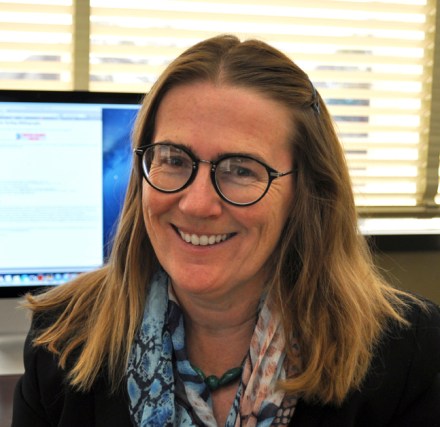
Sharon Radcliffe has been a librarian working in public, academic and special libraries, including the Environmental Protection Agency, for over 25 years. She is currently the Business Librarian at California State University, East Bay where she serves on the Sustainability Committee. She recently attended the Sustainability Across the Curriculum Leadership Workshop at CSU Channel Islands, sponsored by the Association for Advancement of Sustainability in Higher Education (AASHE). At CSU East Bay She has helped develop Institutional Learning Outcomes in both sustainability and information literacy and also helped draft course descriptions for the new sustainability minor. She also developed student internship descriptions for the “Academic Core” building project, which will house the new library. She is involved in many ways in promoting sustainability at CSU East Bay through her teaching and work on the sustainability committee. As library faculty library liaison for the College of Business and Economics, she also selects books for the library on sustainability from a business and economic perspective. She has taught many online courses on business research, research methodology, visual literacy, and learning theory for both RUSA and Simmons College of Library and Information Studies.
C&CS is supported by PaLA and the CRD, and we thank them for our support. The session will be made available on the C&CS page after the session. If you would like to participate as a speaker for the series, please let us know! https://crdpala.org/connect-communicate/
Imagine not having access to printed works due to blindness, a visual impairment, or a perceptual or reading disability, such as dyslexia. Imagine not having the ability to focus your eyes on printed material or not being able to handle or manipulate a book in your hands due to autism or Parkinson’s disease. The miracle of picking up a book, reading it, comprehending the material on the page, and filing it away for future access and dissemination is something which the majority of us simply take for granted. A trip to your local public library might reveal a selection of audiobooks and large print titles, which certainly are accessible alternatives to the standard print format. Be that as it may, astonishingly less than 7% of published books are made available globally in these alternative formats, which in addition to audio and large print, also includes Braille and Digital Accessible Information System (DAISY) formats.
The World Intellectual Property Organization (WIPO), a specialized agency of the United Nations, declares that this lack of equal accessibility has been a key factor of the book famine which plagues our world. The Marrakesh Treaty, which states that “without books, journals, and magazines, people are cut off from life,” was developed by the WIPO in 2013 and later entered into force in September of 2016. It created obligatory changes which, by becoming national law, would grant equal access to printed materials. Since then, many countries have been bringing their copyright laws into accordance with the Marrakesh Treaty on the grounds that they are either party to the Treaty or because they intend to join the Treaty in the near future. Obstacles due to copyright law are a partial reason behind the limited access to alternative formats of printed materials, and the Marrakesh Treaty seeks to address these obstacles.
We believe that the Marrakesh Treaty is the most significant development in the lives of blind and visually impaired people since the invention of Braille, nearly 200 years ago.”
Penny Hartin, Chief Executive Officer
World Blind Union
The World Blind Union (WBU) first proposed a draft of the treaty to the WIPO members. The International Federation of Library Associations and Institutions (IFLA), along with other library partners, strongly supported negotiations which lasted over five years at the WIPO, and participated in the Diplomatic Conference in Marrakesh, Morroco, which saw the Treaty’s implementation. Hence, libraries are really at the forefront of this necessary accommodation.
The Marrakesh treaty may be accessed here.
Information has been retrieved from the document Getting Started: Implementing the Marrakesh Treaty for persons with print disabilities: A practical guide for librarians.
C&CS Update + “Haunted Libraries” Link
Hi all, just an update from the Connect and Communicate Team!
We are working hard to coordinate our spring programming, but do have a session scheduled on Nov 16! More details about that will be coming soon.
In the meantime, our page contains some of the past sessions from this group, and since it’s the season, I’m just going to leave the link for Mark’s “Haunted Libraries” (2017) talk here:
Enjoy your Halloween candies and parties!
~Erin
Lewy Body Dementia Awareness Month
Although most people have heard of Alzheimer’s Disease and other forms of dementia, Lewy Body Dementia is a type of dementia that few people have heard of, yet 1.4 million people have been diagnosed in the United States. As academic librarians, we can help to make more people aware of this disorder, so that more people with LBD can be accurately diagnosed. Even within the medical profession, many people have little knowledge of this disease so educating our students enrolled in the health sciences is extremely important.
A correct diagnosis is required so that proper treatment can begin. Many medications, which improve other forms of dementia, can make Lewy Body Dementia worse. Sadly, many people can see multiple doctors over several years before they are correctly diagnosed with LBD. In addition, there are physical symptoms not present in other types of dementia and so physical, occupational, and speech therapy may be necessary. There is no cure, but proper treatment can significantly improve the quality of a patient’s life.
October is Lewy Body Dementia Awareness month. For more information, contact the Lewy Body Dementia Association.
Gettin’ Ready for Open Access Week
Earlier this year SPARC®, the Scholarly Publishing and Academic Resources Coalition, announced its theme for International Open Access Week: “designing equitable foundations for open knowledge.” The Advisory Committee also fixed the dates as October 22-28.
Image courtesy of SPARC® Website.
Falvey, the library for Villanova University, has for many years held events highlighting Open Access, but we’re frequently a bit freer about it. So, it’s more like Open Access month.
However during the official week this year Falvey will have an Open Access Week information table in a public space in the library for sharing information about getting full text fast via unpaywall.com and openaccessbutton.org. We will be screening “Paywall: The Business of Scholarship,” and co-sponsoring with Villanova University’s Lepage Center for History in the Public Interest a discussion of the documentary elsewhere on campus the next day.
Another event for Open Access Week this year is a Brown Bag for faculty led by librarians on Open Access scholarship and publishing where a major topic will be SOAR, Falvey’s Scholarship Open Access Reserve fund initiative.
Whether event’s are during the official week or not, it is helpful to remember SPARC’s “official hashtag of Open Access Week is #OAweek.” For more information go to: www.openaccessweek.org.


 Adam Balcziunas
 Alex K.
 Alexandrea Glenn
 Andrea Pritt
 aprilnkelley
 Ashley Purvis
 Bethann Rea
 blj13
blj13 Brendan Johnson
 Amanda Boyer
 Bret Stiffler
 Bonnie Powers
 Christopher Lemery
 clarewithers
 clblibrarian
 Kelly Clever
 Charlotte M. Johnson
 colemanluzerne
 CRD of PaLA
 crdvirtualjournalclub
 cre5314
 csgarth
 Erin B.
 danajkerrigancv
 denisewetzel1
 Darren G. Poley
 elm43
elm43 James D'Annibale
 Annie Jansen
 Jill Hallam-Miller
 jennifercribbs
 Jenn Monnin
 Jen Hasse
 Jessica Showalter
 johnmeier1
 Kelly Safin
 Kim Karim
 Kristen Seikaly
 Kayla Van Osten
 Cecelia Lasley
 librarianjsmith
 Linda Neyer
 mabogino1
 Matthew McNelis
 Meg Massey
 Maggie Savidakis-Dunn
 Rebecca
 miskatoniclibrarian
 Maureen Bentz
 Michele G. Anfuso
 Nicole Miyashiro
 paulmcmonigle
 Rob Sieczkiewicz
 ronlmccoll
 Sam Bardarik
 shannahollich
 smartin592
 Ula Lechtenberg
 It's Academic