Acquiring New Collections and Strengthening Liaison Relationships
At Pitt, I’m part of a team of liaisons to our School of Public and International Affairs (SPIA), so I look at their website regularly in order to stay current with any news or events. Recently, I happened to be looking at the Johnson Institute for Responsible Leadership website and came across a portion of the site entitled “library.” Intrigued, I looked at it and discovered the Institute had a small print lending library of books on leadership and management. The website featured simple lists of books and I thought the lists could benefit from the addition of hyperlinks to our PittCat discovery layer records of the same titles. This would particularly benefit any remote learning student when ebooks were available. Additionally, it would expand the reach of the library to anyone who was unable to visit it in person. This prompted me to contacted Johnson Institute director Julia Santucci to offer to provide the links. I had done instruction sessions for some of Julia’s classes, so we already had a rapport. Julia arranged a time to meet and discuss this further.
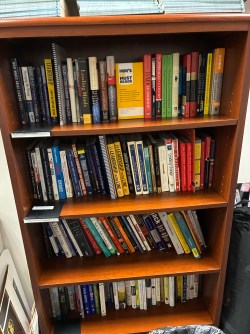
During our meeting, Julia and I took a look at the collection (pictured). Julia said that the library didn’t get a lot of use and hadn’t been expanded in quite some time. Julia expressed a desire to connect the Institute’s library with the Pitt Libraries’ holdings on similar topics. This immediately brought to mind a then-recent call by my some of my colleagues for candidates for pilot PittCat Collections. PittCat is our version of ExLibris’ Primo VE discovery layer; Primo VE Collections allow libraries to increase item visibility. Collections are an optional feature, so it would take some work to get them started. Since the Institute library would be an excellent candidate for a Collection, I began a discussion with my colleagues to start the process.
For Collection creation, the first thing we needed was a master list of the Institute library titles to compare with the Pitt Libraries holdings. I did this analysis in a simple Excel spreadsheet since it was the most straightforward way. Before I put the spreadsheet together, I surmised that the Pitt Libraries already had 80%-90% of the Institute Library items. In reality, we ended up only having about 66% of the items on the Institute’s list. Once I sent this spreadsheet to my colleagues, they indicated that creating the Collection would only work if the items had PittCat records. That prompted a conversation with Julia as to whether it would be best if the Pitt Libraries ingested the Institute Library collection. In another instance of great timing, Julia was thinking along the same lines: the Institute offices were due to be renovated in May 2026 and there wasn’t going to be room for the library.
After talking through the logistics, we’re now finalizing the handover of the Institute library materials that the Pitt Libraries don’t already have. Once we get them added to PittCat and the new Collection, the usage of these materials will hopefully increase. PittCat integration will also allow Collection users to explore our other literature on related topics, thereby expanding their horizons. This process has strengthened our relationship with SPIA; added some valuable items to our holdings; and helped contribute to a library initiative. All great outcomes from finding something on a website!


 Adam Balcziunas
 Alex K.
 Alexandrea Glenn
 Andrea Pritt
 aprilnkelley
 Ashley Purvis
 Bethann Rea
 blj13
blj13 Brendan Johnson
 Amanda Boyer
 Bret Stiffler
 Bonnie Powers
 Christopher Lemery
 clarewithers
 clblibrarian
 Kelly Clever
 Charlotte M. Johnson
 colemanluzerne
 CRD of PaLA
 crdvirtualjournalclub
 cre5314
 csgarth
 Erin B.
 danajkerrigancv
 denisewetzel1
 Darren G. Poley
 elm43
elm43 James D'Annibale
 Annie Jansen
 Jill Hallam-Miller
 jennifercribbs
 Jenn Monnin
 Jen Hasse
 Jessica Showalter
 johnmeier1
 Kelly Safin
 Kim Karim
 Kristen Seikaly
 Kayla Van Osten
 Cecelia Lasley
 librarianjsmith
 Linda Neyer
 mabogino1
 Matthew McNelis
 Meg Massey
 Maggie Savidakis-Dunn
 Rebecca
 miskatoniclibrarian
 Maureen Bentz
 Michele G. Anfuso
 Nicole Miyashiro
 paulmcmonigle
 Rob Sieczkiewicz
 ronlmccoll
 Sam Bardarik
 shannahollich
 smartin592
 Ula Lechtenberg
 It's Academic